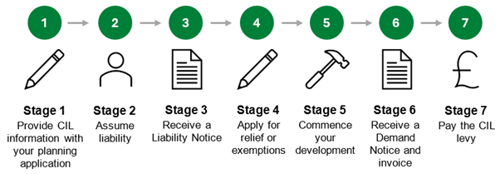
Stage 1 - Provide information with your planning application
If you think that your development is or may be liable for CIL, when you apply for planning permission you should submit the CIL Additional Information Form alongside your other application documents. Guidance on which types of development are liable for CIL is available on our website.
The information you provide on this form will help us to determine whether your development is liable for CIL and whether you might be eligible for relief or exemptions.
Permitted development
If your development does not require planning permission (usually known as permitted developments), it may still be liable for CIL. In this instance, you must submit a Notice of Chargeable Development to us before you start your development.
Stage 2 - Assuming liability
If you are the person (or company) who intends to pay for the CIL liability for a development, you must notify us of this by submitting an Assumption of Liability Form. Any person can assume liability – you may be the landowner, the developer, or another person.
The form to assume liability can be submitted at any point up until the day before you start the development.
It is important to be aware that if nobody has assumed liability when your development commences, the landowner(s) will become liable by default and surcharges may be applied. You will also lose the right to pay by instalments.
Can multiple parties assume liability?
Yes, more than one person can assume liability for the same development. When this happens, each person becomes jointly liable to pay the full calculated CIL charge.
If your planning permission is a phased permission, different people can assume liability for the individual phases of the development, and they will be liable only for the CIL charge calculated for that portion of the development.
Can I withdraw or transfer liability to another party?
If you have assumed liability for a development but wish to withdraw that assumption, you may do so before the development has commenced by submitting a Withdrawal of Liability Form. You cannot withdraw liability after the development has started.
If you have assumed liability but wish to transfer the liability to another person, you can do so any time up until the due date for the final instalment of the CIL charge. A Transfer of Liability Form, completed by both the original and new liable persons, must be submitted to the Council. You cannot transfer liability to someone else after the final payment is due.
Stage 3 - Issue of the Liability Notice
Once your planning permission has been granted or we have received a Notice of Chargeable Development from you, we will issue you with a CIL Liability Notice.
If someone has already assumed liability, the Liability Notice will be served on that person. It will also be served on the applicant for the planning permission and any other person known to the Council as an owner of the land. If nobody has assumed liability, the Liability Notice will be served on the applicant and any landowners.
The Liability Notice will show the chargeable floorspace of the development and the resulting CIL charge. You can find out more about how the CIL charge is calculated on our website.
A revised Liability Notice may be issued by the Council at any point that the liability changes. This may be a result of changes to the liable person(s), where relief has been granted, where the planning permission is amended, or where surcharges are applied. Whenever a revised Liability Notice is issued, any previous Liability Notice issued for that development no longer has effect.
How can I appeal the CIL charge calculations?
If you think that the amount of CIL charge has been calculated incorrectly, then you may request that we recalculate it. You can do so by completing the Request for Review of Chargeable Amount form online or submitting your request in writing. A request for review must be submitted within 28 days of the date of issue of the Liability Notice, and you must not have commenced the development.
The Council will recalculate the levy and will either confirm the original amount or will issue a revised Liability Notice with any recalculated amount.
If, following this process, you still believe the amount is incorrect you may appeal to the Valuation Office Agency. An appeal must be made within 60 days of the date of issue of the Liability Notice, and you must not have commenced the development.
Local Land Charges register
When a Liability Notice is issued, the CIL charge identified on that notice will be registered as a charge on the Local Land Charges register. This means that the liability is held as a charge on the land and will appear in searches of the register. If a CIL charge is unpaid, the outstanding liability may affect your ability to sell your land or property in future.
Stage 4 - Applying for exemptions or relief
In some cases, a development may be eligible for exemption or relief from a CIL liability. You can find further information on the types of exemptions and relief available on our website.
Exemptions or relief are not automatically applied and require you to apply to the Council and, where relevant, provide supporting documentation.
Application forms for self-build exemptions, charitable and social housing relief, exceptional circumstances relief, further exemption claim forms and phase credit applications are available via the Planning Portal. Forms must be submitted to CIL@bassetlaw.gov.uk or mailed to the Council’s offices.
To apply for relief, you must:
- Have already assumed liability to pay CIL on the relevant development or do so at the same time as your relief application.
- Have not yet commenced development. If you have already started your development, the Council is not able to issue any relief or exemptions.
When you apply for relief or exemption, we will first acknowledge receipt in writing and then consider the application. Where an exemption or relief is granted, the Council will issue the decision in writing and will also issue a revised Liability Notice reflecting the relief granted. If you are unsuccessful, we will send you a letter explaining why.
If you are granted relief or exemption, we may advise you of further conditions that you must follow. This might include further steps you must do, or specific actions you must not do, both before you start your development and potentially even after your development is complete. If you do not meet these conditions, your relief may be withdrawn, and the original CIL charge amount becomes payable.
Where relief is subject to conditions, the original CIL charge amount (before relief is applied) remains as a charge on the Local Land Charges register until the relevant period has expired. The Planning Portal website contains further guidance on requirements for relief and exemptions.
Do I have the right of appeal against relief decisions?
There are limited opportunities to appeal the decisions of the Council in relation to applications for relief. The times you may appeal are:
- Charitable Relief – a person may appeal the decision of the Council to grant charitable relief on the ground that the Council has incorrectly determined the value of the interest in land in respect of which the claim was allowed.
- Residential Annex Relief – a person may appeal the decision of the Council to grant residential annex relief on the ground that the Council has incorrectly determined that the development is not wholly within the curtilage of the main dwelling.
- Self-Build Housing Relief – a person may appeal the decision of the Council to grant self-build housing relief on the ground that the Council has incorrectly determined the value of the exemption allowed.
If you wish to make such an appeal, you may do so to the Valuation Office Agency. You must submit your appeal within 28 days from the date in which Council issued its decision on the relief application, and you cannot start your development before the appeal is decided.
Stage 5 - Commencement of development
You must notify the Council of your intention to commence your development. To do so, you need to send us a CIL Commencement Notice advising of your intended start date, and we must receive this notice at least one day prior. Please send the form to CIL@bassetlaw.gov.uk or mail it to the Council’s offices. Importantly, notifying other parts of the Council of your commencement (such as Building Control) is not sufficient notice for the purposes of the CIL.
Your form must include the planning application reference number and the relevant Liability Notice reference number for it to be valid – you can find both numbers in the Liability Notice issued to you.
If you start your development without notifying us at least one day prior, you may become liable to pay a penalty surcharge and will lose any right to pay by instalments. If you had been granted any relief or exemptions, this relief will also be lost, and you will become liable to pay the full original CIL charge amount.
The surcharge for failing to submit a Commencement Notice is 20% of the total CIL charge amount due up to a maximum of £2,500.
What if my intended start date changes?
If you have sent us a Commencement Notice but later decide to change the intended start date for your development, you must advise us in writing as soon as possible. You can either tell us at that time what your new intended start date is if you know what it will be, or you can withdraw your current notice and send us a new Commencement Notice later.
If your original intended commencement date has passed and we have already issued you with a CIL Demand Notice, we may require you to provide evidence that your development has not yet started (such as time-stamped photographs of the land).
What is classed as commencement?
In accordance with the Community Infrastructure Levy Regulations 2010 (as amended), development commences on the earliest date on which any material operation begins to be carried out on the relevant land.
Material operation is further defined in Section 56(4) of the Town and Country Planning Act 1990, and includes:
- Construction work towards the erection of a building
- The demolition of a building
- The digging of trenches for foundations of a building
- The laying of pipes, mains or foundations
- The laying out or construction of a road or part of a road
- Any change of use of land which constitutes material development
Can I appeal against a deemed commencement date?
If you start your development without notifying us beforehand, the Council will determine the date it believes commencement occurred. You may appeal against a deemed commencement date. To do so, you must submit your appeal to the Planning Inspectorate within 28 days of the date the Demand Notice was issued.
Stage 6 - Issue of Demand Notice
Once you start your development, the CIL charge becomes payable. The Council will issue a Demand Notice and accompanying invoice to each person(s) who has assumed liability to pay the CIL.
The Demand Notice will set out the CIL charge amount and the payment due date. If you are eligible, the notice and invoice may allow you to pay in instalments and will set out instalment amounts and respective due dates.
If nobody has assumed liability, we will apportion the CIL liability between the landowner(s), and each will be required to pay their portion of the charge.
The Demand Notice will be registered as a charge alongside the Liability Notice on the Local Land Charges register.
How can I appeal the apportionment of liability?
Where the Council has been required to apportion liability amongst multiple landowners, an affected person who is aggrieved at the way the apportionment was calculated may make an appeal to the Valuation Office Agency. An appeal must be made within 28 days of the day on which the Demand Notice was issued.
Stage 7 - Making payments
Payment of the CIL charge must be made directly to the Council. The Demand Notice and accompanying invoice will tell you the payment methods available.
When we receive a payment from you, we will acknowledge this is writing. After you have paid your final instalment, unless further conditions apply relating to relief or exemptions that have been granted, we will also remove the charge from the Local Land Charges register and send you a CIL Discharge Notice.
What are the consequences of failing to pay?
It is important to be aware that the CIL is not a negotiated process. If a development is liable for CIL, under the CIL Regulations 2010 (as amended) the payment is mandatory (except where relief has been granted). There are strong enforcement powers and penalties for a failure to pay a CIL liability.
Further information on the possible consequences of failing to pay a CIL charge can be found in the CIL Enforcement Guidance Note.
Last Updated on Thursday, April 23, 2026