On this page
- Introduction
- Context
- Policy Statement
- Scope
- Groups, 29 Hazards and Vulnerabilities
- Emergency Hazards (Category 1)
- Significant Hazards (Category 2)
- Decants (Required Moves)
- GDPR
- Defence
- Surveys
- Post Inspections
- Record Keeping
- Training
- Responsibility and Decision-Making
- Associated Policies and Procedures
Introduction
Phase 1 of Awaab’s Law came into force for the social rented sector on 27 October 2025, which requires all social landlords to address all emergency hazards, all damp and mould and all significant hazards present risk of harm to tenants to fixed timeframes.
In 2026 the regulations will be extended to include the following hazards where they present a significant risk of harm:
- excess cold and excess heat
- falls associated with baths etc., on level surfaces, on stairs and between levels
- structural collapse, and explosions
- fire, and electrical hazards
- domestic and personal hygiene and food safety
In 2027, the regulations will be further extended to all remaining HHSRS hazards (apart from overcrowding) where they present a significant risk of harm.
Bassetlaw District Council (BDC) will prepare for the future expansion of Awaab’s Law. This guidance includes information in relation to damp and mould hazards that are included in the first phase of Awaab’s Law and will be updated to include other hazards ahead of them coming into force of further phases. We want to make sure that this policy works effectively through taking a ‘test and learn’ approach and will implement any lessons learned between phases.
The phased approach does not mean that BDC have leeway on addressing dangerous issues in our homes in the meantime and therefore we must continue to meet our legal duties to keep homes safe by fixing disrepair, and keeping our homes fit for human habitation and free of dangerous ‘category 1’ health or safety hazards. We will also continue to meet the outcomes set out by the Regulator of Social Housing in its Safety and Quality standard.
Context
The Regulations are also known as ‘Awaab’s Law’ in memory of 2-year-old Awaab Ishak, who died tragically in 2020 as a result of a severe respiratory condition due to prolonged exposure to mould in his home. Awaab’s parents had complained repeatedly to their social landlord in the three years prior to Awaab’s death, but no action was taken by their social landlord to treat the mould.
Living in hazardous conditions can have a substantial impact on people’s health, safety and wellbeing. While many landlords take timely and effective action to address hazards, Awaab’s Law serves as a legal backstop for the cases where social landlords are failing to make repairs quickly enough, leaving their tenants at risk.
The primary legislation for Awaab’s Law was first introduced through the Social Housing (Regulation) Act 2023, and inserts (or in legal terms ‘implies’) into social housing tenancy agreements a term that requires social landlords to comply with the requirements that are set out in these Regulations. This means all social landlords have to meet the requirements in the Hazards in Social Housing (Prescribed Requirements) (England) Regulations 2025. If they do not, tenants can hold their social landlords to account by taking legal action through the courts for a breach of contract. Other avenues of redress are available to tenants via the social landlord’s complaints procedure and the Housing Ombudsman Service.
Policy Statement
BDC is committed to meeting its legal duties to keep our homes safe by fixing disrepair and keeping them fit for human habitation and free of ‘category 1’ hazards ensuring that all our homes and communal areas managed by BDC Housing Services are safe and healthy for tenants and visitors. This policy outlines our approach under HHSRS to identify, assess, mitigate and eliminate hazards.
BDC will comply with relevant legislation and guidance, including:
- Health and Safety at Work etc Act 1974
- Housing Act 2024
- Defective Premises Act 1972
- Landlord and Tenant Act 1985
- Homes (Fitness for Human Habitation) Act 2018
- Decent Homes Standard 2006
- Consumer Regulations 2024 – Regulator for Social Housing
- Pre-Action Protocol for Housing Conditions Claims (England), 2021
- Social Housing (Regulation) Act 2023
- Hazards in Social Housing (Prescribed Requirements) (England) Regulations 2025.
Scope
This policy and procedure applies to all properties and communal areas managed by BDC – Housing Services where we hold responsibility for repairs and maintenance.
This policy does not apply to:
- Leasehold properties
- Any other dwelling/building managed by BDC which are not otherwise included in the property portfolio of Housing Services
- Hazards resulting from a breach of tenancy agreement by the resident, including deliberate damage or unauthorised alterations
- Hazards which are ‘non-significant’ hazards otherwise known as Category 3 or 4 hazards.
Leaseholders are responsible for repairs within their demised premises, as outlined in their lease agreements. If the issues arise within the communal area or involves a structural building defect, BDC is responsible for carrying out the repairs in line with the terms of the relevant lease agreement.
Hazards that pose a significant risk to the health or safety of our tenants within the affected home fall within scope of Awaab’s Law. BDC is responsible for determining whether a hazard poses a significant risk to a customer(s) health or safety.
This policy has been developed to ensure full compliance with all HHSRS hazards falling within the scope of Awaab’s Law, including those introduced through its phased implementation from 27 October 2025 onwards.
Definitions
| Term | Definition |
|---|---|
| Housing Health and Safety Rating System (HHSRS) | The risk-based evaluation tool used to assess potential hazards in residential properties, as defined under the Housing Act 2004 |
| Emergency Hazard (Category 1) | An emergency hazard otherwise known as Category 1 hazards are those that poses ‘an imminent and significant risk of harm’ to the health or safety of the tenant. |
| Significant Hazard (Category 2) | A ‘significant hazard’ otherwise known as Category 2 hazards are those that poses a ‘significant risk of harm’ to the health or safety of a tenant. A ‘significant risk of harm’ is defined as ‘a risk of harm to the occupier’s health or safety that a reasonable lessor with the relevant knowledge would take steps to make safe as a matter of urgency’. |
| Non-Significant Risk (Category 3 and 4) | A ‘non-significant’ otherwise known as Category 3 or 4 hazards are those that do not pose a serious threat to health or safety and would not require urgent action by a reasonable social landlord. These hazards are outside the scope of this policy. |
Groups, 29 Hazards and Vulnerabilities
A potential source of harm or adverse health effect on a person. Under HHSRS there are currently 29 hazards of which the most common are damp and mould, excess cold, falls and fire safety. These fall into 4 Groups A – D:
| Groups | Hazards | Vulnerabilities | Responsible Team / Department |
|---|---|---|---|
| a | b | c | d |
| Group A: Physiological Requirements | 1. Damp and mould growth | 14 years or less | Repairs - DMC |
| 2. Excess cold | 65 years plus | P&D - Compliance | |
| 3. Excell heat | 65 years plus | P&D - Compliance | |
| 4. Asbestos and manufactures mineral fibres | No specific group | P&D - Compliance | |
| 5. Biocides | No specific group | P&D - Compliance | |
| 6. Carbon monoxide and combustible products | CO, 65 years plus NO₂ SO₂ and smoke – No specific group |
P&D - Compliance | |
| 7. Lead | Under 3 years | P&D - Compliance | |
| 8. Radiation | All persons aged between 60-64 who have had lifetime exposure to radon | P&D - Compliance | |
| 9. Un-combusted fuel gas | No specific group | P&D - Compliance | |
| 10. Volatile organic compounds | No specific group | P&D - Compliance | |
| Group B: Physiological Requirements | 11. Crowding and space | No specific group | HO |
| 12. Entry by intruders | No specific group | Customer Services | |
| 13. Lighting | No specific group | Customer Services | |
| 14. Noise | No specific group | HO - ASB | |
| Group C: Protection Against Infection | 15. Domestic hygiene, pests and refuse | No specific group | HO |
| 16. Food safety | No specific group | HO | |
| 17. Personal hygiene sanitation and drainage | Under 5 years | HO - Personal Hygiene Customer Services - Drainage | |
| 18. Water supply | No specific group | Repairs - P&D | |
| Group D: Protection Against Accidents | 19. Falls associated with | 60 years plus | Repairs - P&D |
| 20. Falling on level surfaces etc | 60 years plus | Repairs - P&D | |
| 21. Falling on stairs | 60 years plus | Repairs - P&D | |
| 22. Falling between levels | Under 5 years | Repairs - P&D | |
| 23. Electrical hazards | No specific group | Repairs - P&D | |
| 24. Fire | No specific group | Repairs - P&D | |
| 25. Flames, hot surfaces and materials | No specific group | HO | |
| 26. Collision and entrapment | No specific group | HO | |
| 27. Explosions | No specific group | Repairs - P&D | |
| 28. Ergonomics | No specific group | Repairs - P&D | |
| 29. Structural collapse and falling element | No specific group | Repairs - P&D |
Emergency Hazards (Category 1)
Step 1 – (Day Zero) A potential emergency hazard is reported, or a BDC colleague or contractor identifies a potential emergency hazard during a property visit.
Immediately inform either Responsive Repairs, DMC or Property & Development team
Responsive Repairs, DMC or Property & Development assigns the case to a supervisor or building Surveyor
The assigned supervisor/surveyor then reviews all available information about the hazard and the resident’s circumstances. Based on this, they make an initial assessment to decide whether the issue is a potential ‘emergency hazard or if it needs to be downgraded to a significant’ hazard or if it falls outside the scope of Awaab’s Law
The supervisor/surveyor must further investigate and visit the property if after reviewing all available information concludes the presence of a potential emergency hazard. If the investigation confirms an emergency hazard at the property, then the supervisor/surveyor must arrange for the relevant safety work to be undertaken as soon as reasonably practicable. The investigation and the work must both take place within 24 hours of becoming aware of the hazard.
Significant Hazards (Category 2)
Step 1 – (Day Zero) A potential significant hazard is reported, or a BDC employee or contractor identifies a potential significant hazard during a property visit.
- Immediately inform either Responsive Repairs, DMC or Property & Development team
- Responsive Repairs, DMC or Property & Development assigns the case to a supervisor or building surveyor
- The assigned supervisor/surveyor then reviews all available information about the hazard and the resident’s circumstances. Based on this, they make an initial assessment to decide whether the issue is a potential ‘significant’ or needs upgrading to an ‘emergency’ hazard, or if it falls outside the scope of Awaab’s Law.
Step 2 - If a potential significant hazard is identified, the assigned supervisor/surveyor must carry out an investigation within 10 working days. If their investigation confirms a significant hazard, they must:
- Provide a written summary of the investigation and its findings to the resident within 3 working days of the conclusion (unless the property is made safe and works are completed within 3 working days)
- Complete relevant safety works and begins or take steps to begin any further supplementary works to prevent the hazard from reoccurring within 5 working days of concluding the investigation
- Where further supplementary works are required and it is not possible to begin them within 5 working days, then BDC must start these as soon as reasonably practicable and within 12 weeks of the investigating concluding.
This diagram shows a simplified process to support understanding of Awaab’s Law timeframes resolving a significant or emergency hazards, full details of which can be found within the guidance.
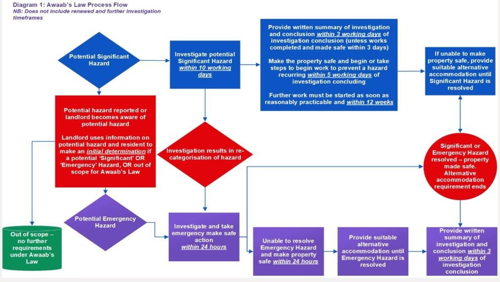 The process begins when a potential hazard is reported or a landlord becomes aware of a hazard. The landlord makes an initial assessment to determine whether the issue is a potential significant hazard, a potential emergency hazard, or out of scope for Awaab’s Law. Out-of-scope cases require no further action under the law. For a potential significant hazard, the landlord must investigate within 10 working days. Following investigation, the hazard is categorised. If confirmed as a significant hazard, the landlord must: Provide a written investigation summary and conclusion within 3 working days of the investigation ending. Make the property safe and take steps to prevent recurrence within 5 working days of the investigation ending. Begin any further necessary work as soon as reasonably practicable and within 12 weeks. If the property cannot be made safe immediately, suitable alternative accommodation must be provided until the hazard is resolved. For a potential emergency hazard, the landlord must investigate and make the property safe within 24 hours. If the emergency hazard cannot be resolved within 24 hours, suitable alternative accommodation must be provided until the hazard is resolved. A written summary of the investigation and conclusions must be provided within 3 working days of the investigation ending. The process concludes when the significant or emergency hazard is resolved, at which point any requirement to provide alternative accommodation ends. Note: The diagram states that the timescales do not include renewed or further investigations.
Renewed Investigations
If a tenant specifically requests an in-person inspection after an investigation has been done remotely, a ‘renewed’ in-person investigation must be carried out. For potential significant hazards, the renewed investigation must be completed within 10 working days of the request, so the timeline for investigation is effectively reset.
This must confirm whether or not there is a significant or emergency hazard and must also, if possible, identify the required work to make a property safe and prevent the hazard from recurring.
Tenants should therefore be encouraged to request an in-person inspection in the first instance if they believe one is required. For potential emergency hazards, the tenant may request an in-person investigation within 10 working days if an initial remote investigation concludes there is not an emergency hazard or if the initial investigation finds an emergency hazard but does not identify any relevant safety work to address the emergency hazard.
Under Awaab’s Law, BDC are not required to undertake a renewed investigation if required works to prevent the hazard from recurring have already begun, or if relevant safety work under regulation 5 (emergency action) or a further investigation (under regulation 8) is required. However, in a case where a further investigation is required BDC will conduct an in-person inspection under the provision relating to further investigations, if the tenant so requests.
The process flow shows a hypothetical scenario and simplistic example of a renewed investigation. This example is not reflective of all possible circumstances and should not be relied upon exclusively for understanding the requirements.
The timeline progresses from left to right: Day 0: A potential hazard is reported, or the landlord becomes aware of a potential hazard. Day 0: The landlord uses available information and categorises the issue as a Significant Hazard. Day 2: The landlord reviews available information and completes a virtual investigation within 10 days. The investigation concludes that there is no significant or emergency hazard. Day 3: The landlord provides a written summary of the investigation and conclusion within 3 working days of the investigation ending, if required. Day 4: The tenant requests an in-person renewed investigation. Day 0 (reset): The landlord must arrange an in-person inspection within 10 working days. A note beneath the flowchart states that the timeframe to investigate resets to Day 0. Day 2 (reset): The landlord uses available information and arranges the in-person inspection within 10 days of the request. Day 5: The in-person investigation takes place and the landlord determines that a Significant Hazard exists. The process then moves to the standard Significant Hazard repair requirements timeline. Note at the top of the diagram: “Example process flow of an in-person inspection for a Significant Hazard where the tenant requests investigation before any works have begun."
Decants (Required Moves)
Securing Suitable Alternative Accommodation
If we are unable to complete the relevant safety work within the initial remediation period (5 working days from the completion of the investigation that identified the hazard for a significant hazard or 24 hours for an emergency hazard), then arrangements will be made to secure the provision of suitable alternative accommodation, until the relevant safety work has been completed.
The provision of suitable alternative accommodation will extend to anybody who usually lives in the property as a member of the tenant’s family and in accordance with the tenancy agreement, including children who would usually stay in the property overnight for at least one night a week.
The ultimate decision as to whether to leave their home and move into alternative accommodation sits with the tenant.
Tenant Refusing Alternative Accommodation
If the tenant refuses the offer of suitable alterative accommodation and chooses to make their own arrangements, then they must inform us in writing.
It should be noted that raising concerns that a property is unsuitable is not the same as refusing an offer of any alternative accommodation. Should the tenant refuse alternative accommodation as an option, it should be made clear to them that BDC is not required to provide further offers of suitable accommodation. However, where a tenant has previously refused an offer of alternative accommodation, BDC will also consider their wider duties, procedures and policies to keep tenants safe.
Remaining in the Property
If anyone chooses to remain in the property in the period before the relevant safety work is completed (for example if an alternative accommodation offer is declined, or if only part of the household move out), then we must provide information on any actions that occupants could take or avoid to mitigate the risk of harm, or let the tenant know if they do not think it is possible for the occupant to do anything to mitigate that risk.
Returning to the Home
Tenants can choose to end the provision of alternative accommodation and return to their home at any time and in doing so the tenant must inform us in writing, resulting in the provisions of the already provided alternative accommodation being brought to an end.
GDPR
Information about tenants is personal data and may be sensitive. GDPR informed consent requires individuals to be fully aware of how their data will be used and to have the power to control their data by freely agreeing, specifically, and unequivocally to the processing. In recording and handling this data, we must ensure that we comply with UK General Data Protection Regulation UK (GDPR) and the Data Protection Act 2018, noting that GDPR places special restrictions on the collection and recording of health data.
Defence
Reasonable Endeavours
BDC have a defence for a failure to comply with Awaab’s Law requirements if they can prove that they have used all reasonable endeavours to avoid it, meaning BDC have taken all reasonable steps to comply with the requirements of the Awaab’s Law, but it has not been possible for reasons genuinely beyond our control. Examples could include:
- Unable to complete work within the timeframes because asbestos removal which would otherwise require a 14-day notification. Likewise, other approvals and permissions might be needed from external bodies, which requires BDC to evidence that appropriate steps to obtain these in good time are being carried out
- Tenant refusing access to the property to enable BDC to complete relevant safety works within the specified timeframes
- Unable to source specialist contractors or materials within the required timeframes but has made reasonable efforts to do so
- BDC have made reasonable efforts to secure suitable alternative accommodation, but there may be no suitable properties which are within a reasonable distance of schools/places of work or in the local area. In this case BDC will work with the tenant to identify the best option
- The tenant no longer wishes to remain in the alternative accommodation, and the tenant gives BDC notice of this in writing.
Surveys
Stock condition surveys will be carried out on a 3-year rolling programme. If during a stock condition survey, the surveyor identifies a Category 1 or 2 hazard then the surveyor must report it immediately to the Property & Development team on 01909 499521 or e-mail propertyanddevelopment@bassetlaw.gov.uk.
On void surveys if the surveyor identifies a Category 1 or 2 hazard then the surveyor must report it immediately to the Property & Development team on 01909 499521 or e-mail propertyanddevelopment@bassetlaw.gov.uk.
On responsive repair surveys if the surveyor identifies a Category 1 or 2 hazard then the surveyor must report it immediately to the Property & Development team on 01909 499521 or e-mail propertyanddevelopment@bassetlaw.gov.uk.
Post Inspections
All remedial works relating to Category 1 or 2 hazards will be post inspected to ensure that the hazard(s) have been mitigated and the remedial works has been completed to a satisfactory standard.
Under Awaab’s Law, there is no requirement to contact tenants post completion of remedial works. However, BDC will periodically contact the tenant after completion of the works to ensure the hazard has not returned at the following intervals:
- 14 days after completion of remedial works
- 2 months after completion of remedial works
- 12 months after completion of remedial works
If the tenant is unwilling or unable to provide access within the above timescales, BDC will not be in breach for missing the timescales and will not record this as a failure. However, we will continue to work with the tenant and arrange access so that we can establish if the remedial works has mitigated the hazard or further works is required.
Record Keeping
Records relating to the case must be maintained, within the Northgate Housing Management System / Civica CX such as:
- Correspondence to and from the tenant
- Correspondence to and from contractors
- Investigation reports
- Completion records/certificates
- Any other record which might otherwise be relevant to the case.
Training
Mandatory HHSRS training requirements for all property visiting colleagues:
| Role | Course Type | Delivery Method |
|---|---|---|
| P&D Managers & Building Surveyors | Enhanced | Virtual or in-person |
| Repairs Manager & Supervisors | Enhanced | Virtual or in-person |
| DMC & Repair Surveyors | Condensed | In-person |
| Building Services Tradesmen | Condensed | Virtual or in-person |
| HO, ASB, Voids team, Income & any other property visiting staff | Condensed | Virtual or in-person |
Training is to be repeated at 3 yearly intervals with records maintained in iTrent.
Responsibility and Decision-Making
The table below illustrates the structure for responsibility and decision-making in relation to this policy.
| Person Responsible | Scope |
|---|---|
| Property & Development Manager | Responsible for the implementation, day-to-day application and adherence to this Policy and Procedure. |
| Head of Housing | Policy owner. |
| Property & Development Manager/ Asset Management Coordinator |
|
| P&D Manager / Repairs Manager | Review and action any HHSRS reports, ensuring that they are actioned within the specified timeframes |
| Compliance Manager | Record monthly on the compliance report any recorded CAT 1 or CAT 2 cases. |
| All frontline staff including BDC contractors |
Identification and reporting of hazards identified during any visit to our homes. |
Associated Policies and Procedures
Associated Policies and Procedures
- Health and Safety Policy Statement
- Repairs & Maintenance Policy
- Damp, Mould & Condensation Policy
- Asbestos Policy
- Electrical Safety Policy
- Fire Safety Policy
- Gas and Heating Policy
- Lift Safety Policy
- Water Hygiene Policy
- Asset Management Strategy
- Complaints Policy
- No Access Procedure
Review
This policy will be reviewed within six months of its initial implementation. Subsequent reviews will occur every three years, or earlier if prompted by changes in legislation, operational requirements, or any other relevant circumstances.
The Director of Regeneration and Neighbourhoods is responsible for leading on the reviewing of this policy, which must include all Responsible Persons listed in the table at 16.1 with exception of frontline staff and contractors.
Last Updated on Tuesday, October 6, 2026