Delivery: April 2026 until 31 March 2027.
Grant Guidance Policy and Information.
Rolling programme (subject to available funding).
Amount per business: Up to £10,000.
Introduction
The Pride in Place Programme is Government’s flagship communities programme which empowers local people to shape the future of their neighbourhood. Supported by up to £5 billion in funding over 10 years, this programme represents a long-term strategy to fix the foundations in hundreds of communities across the country. As part of this funding, Worksop has been allocated 20 million over the next 10 years. The Worksop Together Board’s objectives include creating a vibrant town centre and high street where increased occupancy of retail units and increased town centre footfall is evident. This grant will enable empty buildings to be brought back into use and an allocation of £120,000 capital funding in total for all Business Support Grant Programmes for the financial year 2026-2027 is now available for business support.
These guidance notes have been compiled to give you details to make an informed decision about whether this grant is right for you and your business and ensure you meet the eligibility criteria before you complete an application form.
Bassetlaw is the northernmost District in Nottinghamshire; its boundaries adjoins Derbyshire, South Yorkshire, and Lincolnshire. The city of Sheffield is approximately 25 km to the west, Nottingham is approximately 45 km to the south, and both the A1 and the East Coast Mainline railway run on a north-south axis through the centre of the District. The District is characterised by a range of settlements, from large towns to small hamlets, with a total population of 118,300 people (ONS) of which 59.7% are of working age. Nearly 65% of Bassetlaw’s residents live in its three largest towns, Worksop, Retford, and Harworth & Bircotes. The district is home to over 4000 business 89% of which are micro businesses and 99.8% being within the SME definition.
Worksop, known as the “Gateway to the Dukeries”, has a rich heritage dating back to pre-Norman times, recorded in the Domesday Book (1086). Its medieval roots include the founding of Worksop Priory and the development of a thriving market town under a Royal Charter (1296). The town’s proximity to Sherwood Forest and the historic Dukeries estates shaped its cultural identity. Today residents and visitors can enjoy easy access to Clumber Park, Sherwood Forest, Welbeck, Rufford and Thoresby.
Worksop was originally a small market town known mainly for agriculture and related services. In the late 18th century, it was famous for being one of the biggest producers of liquorice along with hat making (16 hatmakers still in Beaver Place in 1841), and also for the manufacture of Windsor Chairs.
The Industrial Revolution transformed Worksop into a centre for coal mining, timber, and manufacturing, supported by the Chesterfield Canal (1777) and railway links (1849). This industrial legacy fostered strong communities and resilience, which remain central to Worksop’s character today.
Today, Worksop is a historic market town with a population of approximately 44,700 (2021 Census), making it the largest settlement in the Bassetlaw district. Worksop combines traditional market town character with modern amenities.
Worksop has successfully transitioned from its industrial base to a modern economy driven by logistics, advanced manufacturing, and food production, leveraging its strategic location near the A1(M) and M1 corridors.
The local economy in Worksop is now dominated by service industries, manufacturing and distribution. Major employers in the area include Laing O’Rourke, Premier Foods, Greencore, B&Q, Cerealto, DHL, Pandrol, MBA Polymer, Brunton Shaw, Kybotech, and the NHS (Doncaster and Bassetlaw NHS Trust and Nottinghamshire Healthcare NHS Trust). Local income levels are well below national and regional averages.
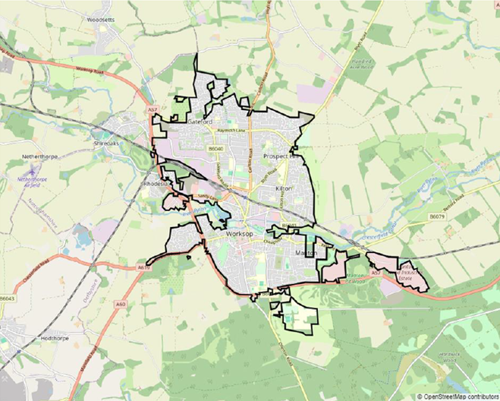
The grant objective
Through Pride in Place, the Worksop Together Board has allocated capital grant funding to support businesses to refurbish shop frontages the high streets and within the town centre in Worksop from April 2026 until March 2027 in the form of a grant. The Worksop Together Board want to reduce the amount of vacant properties within our town centres and diversify the shopping and eating out offer; this grant will give businesses the opportunity to achieve those goals and improve the aesthetic of Worksop town centre shop fronts. This scheme will provide grants for both existing and new businesses that have a viable business growth plan which will lead to the creation of new jobs, improve the visual aesthetics and increase the footfall within the town centres.
Who is eligible for the grant?
The grant is available to independent businesses; these include: sole traders, independent charities, a limited company which would like to replace, improve or carry out repairs to their shop front.
- The shop front façade must be on the ground floor and have a street facing frontage.
- The business should be located within the boundary area shown in map drawing above in Worksop.
- Businesses that have no outstanding debts with the Local Authority.
- If you are a leaseholder, you must have permission from the freeholder and provide supporting documentation.
- Where applicable, planning permission or listed building consent must be obtained from the Local Authority.
Do I require planning permission?
- Planning permission is required for works that involve a material change to the external appearance of a building. Examples of this are alterations to the fascia, the windows or the doorway, changes to the type of material used or the installation of awnings, blinds or security shutters.
- Advertisement consent is required for the display of certain types of signs. You may also require planning permission for change of use to the property.
- If your building is in a conservation area or the building is listed, you may need further permissions. Please ensure you have checked this with our planning dept (details below).
- If you are unsure whether your works require planning permission, you should seek further guidance on planning implications. Please see the contact details below if you’d like to speak to the relevant team within the council for further advice:
- Email – planning@bassetlaw.gov.uk
- Telephone – 01909 533533
- Website - Do I need planning permission? | Bassetlaw District Council
We have also attached the supplementary planning guidance: A guide to good shopfront design and signage from Bassetlaw’s conservation team 2014 which provides excellent examples and background to good shopfront design and signage.
Certain businesses are excluded from applying for this grant - these include pawn brokers, adult/private shops, betting shops, national and international chain stores. Applications will be accepted for commercial premises only; residential properties or home-based businesses are excluded.
Eligible costs:
- Internal and external refurbishments for disability access e.g., disabled toilets, doors, ramps to access building etc.
- Shop fronts (window, door, and signage). The design must be agreed in advance with Bassetlaw District Council planning team.
What can I use the grant for?
The grant can contribute to the following items:
- Replacement shop front windows and doors.
- Reinstatement of traditionally styled shop fronts, sash windows and doors.
- Painting of existing shop frontage and upper floors (including rendering)
- Replacement of guttering and downpipes
- Replacement signage
- Applicable costs for obtaining planning permission and building regulations can be paid for using your own funding.
- Architects’ fees
- Security measures for internal and external grills
- Improving the internal and external accessibility to the premises
Ineligible costs:
The following costs are considered ineligible and must not be included in applications:
- Grants will not be issued to improve shop frontages in properties that will remain vacant.
- Payments for activities of a party political or exclusively religious nature.
- VAT reclaimable from HMRC.
- Gifts, or payments for gifts or donations.
- Statutory fines, criminal fines or penalties.
- Contingencies and contingent liabilities.
- Dividends.
- Bad debts, outstanding business rates, costs resulting from the deferral of payments to creditors, or winding up a company.
- Expenses in respect of litigation, unfair dismissal or other compensation.
- Costs incurred by individuals in setting up and contributing towards private pension schemes.
- Works that have already commenced prior to receipt of the grant offer letter
- Stock
- Rental or lease deposit or costs
- Business rates
- Staff costs
- Insurance costs
- Cleaning products
- Computers, phone, tablets
- Promotional and marketing materials or activities
How to apply for the grant programme
Applicants will need to submit:
- An electronic application form (word/PDF format only). The application form needs to be completed in full, signed and documents requested must be uploaded to support your application.
- The amount of grant you are requesting up to the value of £10,000 and what it will contribute towards.
- A recent copy of a bank statement (covering a period within the last 3-months) to verify the bank account details and to evidence financial standing.
- Independent verification of bank details (preferably verbally) from a trusted source when it’s a large amount
- Verification of your bank account.
- A recent copy of your accounts (if applicable).
- Copies of all relevant permissions for the works/equipment installation where relevant.
- If you are a pre-start or start up business, a business plan will need to be submitted to support the viability of the business (if you have been in operation for less than 6 months).
- You will also be required to illustrate you can provide the following as part of the application form:
3.6 Please indicate and attach to your application the most appropriate one of the following to demonstrate your organisation's financial standing.
- A copy of audited accounts for the last two years
- A statement of the turnover, Profit and Loss Account / Income Statement, Balance Sheet / Statement of Financial Position and Statement of Cash Flow for the most recent year of trading for this organisation.
- A statement of the cash flow forecast for the current year and a bank letter outlining the current cash and credit position.
- Alternative means of demonstrating financial status if any of the above are not available (e.g. forecast of turnover for the current year and a statement of funding provided by the owners and/or the bank, charity accruals accounts or an alternative means of demonstrating financial status).
4. Policies and Liability insurance (max score 3)
| 4.1 Please confirm your organisation has the following* | Yes | No | Under Development | N/A |
|---|---|---|---|---|
| A written health and safety policy | - | - | - | - |
| A written Diversity, Equity and Inclusion Statement | - | - | - | - |
| Public and Employer Liability Insurance to a minimum of £10,000,000 and Professional Indemnity insurance to a minimum of £5,000,000 | - | - | - | - |
*If your application is successful, evidence of policies and insurance will need to be provided prior to being awarded the funding.
Applications must be submitted by the business owner; applications submitted on the business owner’s behalf will not be accepted.
For businesses and charities (up to £10,000):
When is the grant paid?
If the grant application is approved, applicants have up to six months to submit the relevant copies of invoices and bank statements showing eligible expenditure has been made. All invoices and statements must be dated after the grant approval date. All grant funding must be claimed by 31st March 2027.
The payment will be made to the business bank account via BACS payment and VAT will be excluded.
All applications will be subject to an assessment by a panel and the amount offered will be at the discretion of the panel, only whilst the funds are available and awards are on a first come, first served basis. The panel’s decision is final.
Please do not start any works related to your application prior to receiving written confirmation of the panel’s decision. The grant will not be paid towards any transaction that have occurred before the date of approval.
If you are unsure if your requested works or equipment are eligible, please email: worksop.together@bassetlaw.gov.uk
Other important information
Any grant income your business receives is taxable. You must include the grant award as income on your tax return. You’ll only pay tax if your business makes an overall profit once grant income is included.
You will have until the 31st March 2027 to supply evidence of the grant being spent in the form of invoices/receipts. Failure to do so will result in the grant being paid back in full.
Before and after photo evidence will need to be submitted as part of our monitoring requirements and the applicant will be subject to regular monitoring meetings to ensure we are working within the required deadlines.
For further information please contact us via email at: worksop.together@bassetlaw.gov.uk
Last Updated on Thursday, August 27, 2026