Why are we producing a new Local Plan?
The current Local Plan was adopted by the Council in May 2024. We are required by law to prepare a Local Plan and keep it under review every five years. So that our Local Plan stays up to date we need to have a new one in place by 2029. Starting work now gives us enough time to produce a new Plan in this timeframe.
There have also been two key changes since the current Plan was adopted.
The Government published new National Planning Policy in August 2026 (NPP).
The East Midlands Mayoral Combined County Authority (EMCCA) has identified two regional growth areas in Bassetlaw. The Trent Valley Supercluster and Explore Park are expected to provide significant jobs and investment over the next 20 years and beyond.
A new Local Plan covering the period up to 2045 will help us respond to these changes, manage the impacts of growth and make the most of opportunities for local communities, businesses and the environment.
New Local Plan process
The Government has introduced a new Local Plan system. This has changed the way Local Plans are prepared, with the aim of speeding up plan-making and creating shorter, more user-friendly local plans.
The new Plan will be produced over 30-months and will mainly be available in a digital format.
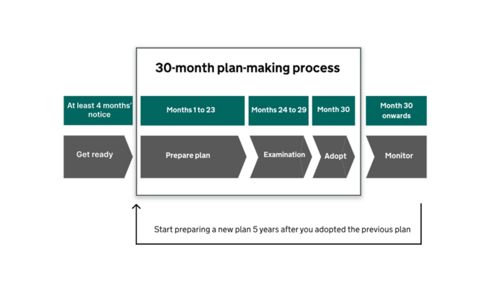
We are at the Get Ready stage and the scoping consultation completes this part of the process. After this, we will move onto producing the new Local Plan, taking on board all the feedback from the Scoping Consultation. We’re then planning to consult on a draft Local Plan in summer 2027.
Because of Local Government Reorganisation, Bassetlaw District Council will remain the Local Planning Authority for Bassetlaw until 31 March 2028. After that, planning responsibility will shift to the new unitary authority. We are working to get the new Plan to an advanced stage so that the new authority can take it forward.
What is the Scoping Consultation?
The scoping consultation is the first stage of full public engagement of the new Bassetlaw Local Plan. This stage is an early opportunity for residents, stakeholders, landowners, and developers to provide comments on what the new Local Plan should include and also say how you would like to engage during the preparation of the Plan.
The scoping report explains what issues we might need to consider and gives an idea about the type of evidence we will have to support our new Plan.
It also explains the type of issues the new Local Plan can’t include. National planning policy now includes National Decision-Making Policies. These are standard national planning policies that will be used when considering planning applications.
Our new Local Plan can’t repeat or conflict with these national policies. But we can focus on the local planning issues that are important to our communities and that will make a difference to the Bassetlaw area.
Employment Growth and Jobs
What is the Trent Valley Supercluster?
The Trent Valley Supercluster is a major regeneration and investment project focused around West Burton, Cottam and High Marnham former power station sites through projects like STEP Fusion at West Burton and green hydrogen at High Marnham. We are working in partnership with the East Midlands Mayor, neighbouring councils and landowners to transform the Trent Valley into a centre for clean energy, innovation and new technology.
The Trent Valley and the rural areas is made up of different landscapes and distinctive villages that contribute to the Bassetlaw's character and identity. The new Local Plan will need to balance future growth with the need to protect the countryside, maintain the character of existing settlements, support farming businesses and help sustain local food production.
Over the next 20 years the Supercluster aims to attract significant investment, bring thousands of jobs, training and education opportunities to the area, support the growth of local businesses and provide for supporting services and facilities.
The new Local Plan will need to consider how Bassetlaw can help improve services and facilities in the rural area for local communities and plan for the growth in a sustainable way that benefits our communities.
Housing targets
The Government now sets out the minimum number of new homes that need to be delivered in Bassetlaw every year. This has increased housing targets for many councils, including Bassetlaw.
As a result, Bassetlaw's minimum annual housing target will increase from 540 homes per year to 643 homes per year from 2029.
This will not all be new housing. Some of the housing sites in the current Local Plan and neighbourhood plans that have not been built yet will be included. This will include previous Local Plan site allocations at Peaks Hill Farm, Worksop and Ordsall South, Retford. Some homes that have planning permission, and some homes completed before the new Local Plan is adopted, are also likely to count towards the future housing target.
To meet the higher target, more land will need to be identified for housing, and we will try to use brownfield sites where possible. Planning for growth through a new Local Plan will help reduce the risk of unplanned development and gives us an opportunity to provide a range of housing for residents. This could include affordable homes and specialist homes designed to meet the needs of an older population.
Infrastructure and the Local Plan
The Local Plan will set out areas of land where new building or development can take place. This is usually for new housing, new businesses or a mixture of both.
The Local Plan has to take into account the impact that this new development will have on the existing services or infrastructure that people use. For example, a new housing development might mean more cars on the road, more children needing to go to school or more people needing to register at the doctors.
The Local Plan will look to address these issues by identifying what new infrastructure will be needed to support the people who will be living or working in these new areas. The Local Plan will then require any developers wishing to build in these areas to either deliver these measures themselves or provide the money for them to be delivered. This could include things like new bus routes, parks, road improvements such as roundabouts and new junctions, new health care facilities and new schools.
However, there are some things that the Local Plan can’t request money for. New development in the Plan cannot address existing problems with services. For example, if there are parking problems outside a school at drop off time, developers can’t pay to address that problem. In addition, developers’ money cannot be used to provide new staff, like nurses or teachers.
Infrastructure is usually funded through money provided by developers to help with the impact of new building. Sometimes the Council will ask for money through Section 106 Agreements (S106). These are payments tied to specific areas, meaning the money has to be spent in the local area. The Council can also use Community Infrastructure Levy (CIL) payments to fund infrastructure improvements. These are raised from developers and can be spent across the District. Other sources of funding could include money from Government or the East Midlands Mayor.
The Local Plan will calculate how much money will be needed to deliver infrastructure development in Bassetlaw up to 2045. It also shows where the money will come from.
Managing Climate Change
The new Local Plan will need to help tackle climate change and support the move towards net zero. This means thinking about issues such as flooding, drought, wildfires, overheating, water supplies, biodiversity and the impact of climate change on our landscapes.
When deciding where new development should go, the Local Plan will need to consider how growth can:
- Reduce greenhouse gas emissions.
- Support more sustainable patterns of development.
- Make communities safer and more resilient to the effects of climate change.
- Ensure the right infrastructure is in place to manage future risks.
Renewable Energy in Bassetlaw
There are two types of planning applications for renewable energy. We assess proposals that generate up to 100MW installed capacity (wind and solar energy) and generate 50MW or less installed capacity (other renewable energy).
Energy projects that generate more capacity are classed as Nationally Significant Infrastructure Projects (NSIPs) and are assessed by the Planning Inspectorate. NSIPs have separate planning policy and won’t be covered by the new Local Plan.
Solar Energy
Natural England splits the country up into different agricultural land categories. Best and most versatile agricultural land is Grade 1, Grade 2 and Grade 3a; other agricultural land is Grade 3b, Grade 4 and non agricultural. These are used by Councils when considering planning applications.
The Council must follow National Planning Policy (NPP) when considering planning applications. NPP requires that all new building should take into account the quality of agricultural land and if significant development of agricultural land is necessary, use areas of poorer quality land where possible.
When submitting planning applications, developers have to show the amount of best and most versatile agricultural land the development would use and explain why this is appropriate.
Through the new Local Plan, we will need to consider where best and most versatile agricultural land is and where possible identify areas for growth that use lower quality land. We will also need to consider options for where different types of renewable energy could go.
Flooding
Does Bassetlaw District Council 'allow' the building of housing developments on floodplains?
The Environment Agency splits the country up into different flood zones (Zone 1 is low probability of flooding, Zone 2 is medium probability, Zone 3a is high probability and Zone 3b is functional floodplain) and these are used by Councils when considering planning applications.
The Council must follow National Planning Policy (NPP) when considering planning applications. NPP requires that all new building should take place in the areas with the lowest risk of flooding.
When submitting planning applications, developers have to show that there are no reasonably available sites at a lower risk of flooding than the ones they want to build on. In Planning Law, this is known as the sequential test.
If the test is passed then the developer will still need to show that the site will be safe for its lifetime, not increase flood risk elsewhere and the benefits of the development outweigh the flood risk. The Council will always carefully consider the advice of the Environment Agency and the Lead Local Flood Authority in respect of any development in areas of high flood risk.
Last Updated on Thursday, September 3, 2026