On This Date
Introduction
This protocol outlines the Local Planning Authority’s approach to negotiating and accepting amendments to planning applications post-submission. This protocol aims to ensure a consistent and transparent approach to decision-making, giving applicants and agents surety and a clear understanding of what to expect when working with us to secure planning permission.
National Planning Policy Framework (NPPF) Policy DM3 (Determining Development Proposals) requires Local Planning Authorities to:
- work with the applicant in a positive and proactive manner, where necessary seeking solutions to problems arising from initial proposals, to enable a timely decision.
- take a proportionate approach to the consideration of the planning matters raised by the proposals, in a way that reflects their scale, complexity and potential impact.
- take account of planning matters raised during any pre-application engagement, including any positive responses to this engagement, as well as representations on the proposals.
Bassetlaw District Council is committed to working with applicants to meet these objectives and aim to continue to build on our record of proactive engagement, whilst setting clear parameters and managing expectations of all parties to achieve this.
We understand that effective negotiations are an important part of the planning process, as they enable schemes to be amended and improved to:
- Meet the requirements of technical consultees, where deemed necessary.
- Address material planning considerations.
- Comply with the requirements of the Development Plan.
- Allow for a pragmatic response to issues as they are identified.
- Improve the overall quality of proposals.
- Allow the grant of permission by overcoming initial shortcomings in schemes.
The guidance below sets out the principles which the Local Planning Authority will seek to apply in determining whether to seek amendments and how it will deal with them.
This protocol is intended to provide a clear framework which establishes the principles underpinning this, whilst acknowledging that no guidance can address all possible eventualities. There may be very exceptional circumstances which could lead to a justifiable divergence from these principles. Please note, however, that any such circumstances will need to be fully justified and exceptional and decisions will be made at the discretion of the Head of Planning and Place and/or the Planning Development Manager.
Furthermore, applicants should note that particularly strategic, large or complex schemes would be more appropriately addressed through the applicant and Council entering into a Planning Performance Agreement to establish a clear project timetable with agreed objectives and milestones. More information about when the Council will seek a PPA and what’s involved is available in the Planning Performance Agreements Protocol.
Pre-application Advice
The ability to make amendments to overcome issues once an application has been submitted should never be an alternative to a properly thought through and prepared application. The Council’s clear preference is for any necessary negotiations to take place before you submit your application, as this improves the process and encourages a ‘right first time’ approach.
This approach is endorsed in the Planning Practice Guidance which states:
“Pre-application engagement by prospective applicants offers significant potential to improve both the efficiency and effectiveness of the planning application system and improve the quality of planning applications and their likelihood of success.”
We therefore strongly encourage those discussions via our comprehensive pre-application advice service before you apply formally. This will generally give more certainty at an earlier stage and help resolve issues so that speedier and simpler decisions can be made. Information and guidance about the services we offer including how to apply, charges, and the timescales for a response, can be viewed online by clicking on the link below:
Pre-Application Advice | Bassetlaw District Council
Applicants should be aware that where no pre-application advice has been sought, or where advice has been sought but not fully taken into account, and issues could reasonably have been identified and addressed before submission, we will normally proceed to refusal without negotiation given the Government’s drive for a speedier planning process. To do otherwise would undermine the role pre-application advice plays in the overall decision-making process and could also elongate the process and result in the Council failing to meet statutory determination periods.
If pre-application advice was given but that advice has been ignored to the extent that proposal is identified, on balance, as being harmful, we will also normally proceed to a refusal without negotiation.
The Council has also published a suite of Supplementary Planning Documents covering a wide range of topic areas and other guidance. This is available to view on our website and should be taken into consideration before submitting a planning application during the design phase of a proposal.
Supplementary Planning Document | Bassetlaw District Council
Negotiating Amendments
Validation
If an application is deemed invalid post submission, you will receive a letter setting out the validation requirements and asking whether you wish to proceed with the application. Unless we hear from you within the timescales set out in the letter and a revised timescale is agreed and adhered to for the submission of any outstanding validation requirements, the application will be returned and the LPA will take no further action in relation to the application.
We shall also arrange for any planning fees paid to be refunded. Please note that if we have to return your application, a 25% administration charge (minimum of £60) will be retained to cover costs incurred by the LPA.
The Council has an up-to-date Local Validation List which details the requirements to submitting a valid planning application. Validation requirements will also be identified through the pre-application process.
Local Validation Requirement | Bassetlaw District Council
During the Application
Any negotiation on the need for amendments must be initiated by the Local Planning Authority. Applicants should not submit unsolicited amendments or additional information once an application has been validated, unless first invited to do so by the Case Officer. Where a consultee has asked for additional information or amendments, the Case Officer will advise whether they consider the request to be proportionate to the type and scale of the proposal and minor in nature. Only where both tests are satisfied would an amendment be invited. There will only be one amendment cycle permitted per application, unless in exceptional circumstances (e.g., an unforeseen change in Case Officer).
The decision to negotiate, or not, always rests with the Case Officer. They are empowered to exercise the discretionary powers of the Council as to whether to accept changes to an application whilst it remains under consideration. Using their professional planning judgement, they will agree the approach to take following the guidance set out in this protocol.
Defining Minor and Substantial Amendments
Minor Amendments
- Not alter the overall scale, layout or form of the proposal.
- Is limited to clarification, corrections or small design adjustments.
- Would not result in the undertaking of new reports or assessments.
- Would not require re-consultation.
- Can be readily achieved within the statutory decision-making timescale.
Substantial (Material) Amendment
An amendment would be substantial (material) if it:
- Changes the site boundary (red line).
- Unsolicited or fundamental change of the description of development.
- Results in a material change to scale, layout, appearance or access.
- Introduces new different or additional uses.
- Changes the planning balance or introduces new material planning considerations.
- Increases impacts on:
- Residential amenity
- Highways safety
- Environmental constraints (e.g., flood risk, ecology, trees etc.)
- Heritage assets
- Seeks to address a scheme that is not acceptable in principle.
Substantial (material) amendments will not be accepted. Instead, a new planning application would be required.
Amendments Decision Framework
For planning applications, the amendment decision framework shall be:
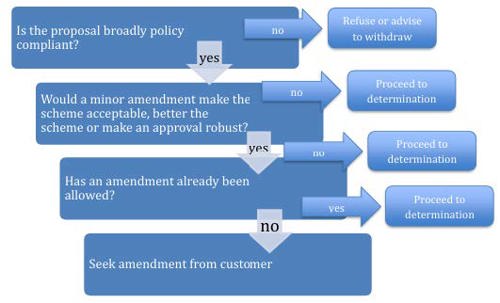
For major development proposals, the Local Planning Authority will use its discretion to provide an element of controlled flexibility to the submission of amendments, where these are consistent with any pre-application advice provided.
Where an application is of one of the following types, it will not be subject to negotiation or requests for amendments:
- Discharge of Conditions.
- Certificates of lawfulness (existing and proposed development).
These are seeking a formal determination from the Council as to whether a development is “lawful” (as set out in Sections 191 & 192 of the Town and Country Planning Act 1990) rather than acceptable having regard to the policies contained within the adopted Development Plan. As such, the Council does not apply any judgement to these application types; they either meet the relevant tests or they do not, and a decision will be made accordingly at the earliest opportunity. - Applications seeking Prior Approval for permitted development where these are time sensitive, and consent is deemed to have been granted by default if a decision is not made within the statutory time frame.
In these instances, the Council would strongly encourage applicants to seek pre-application advice before making their formal submissions for determination. Once submitted as a formal application, these will be assessed and determined based on the original submission only.
Our Expectations of Applicants
Upon receipt of an application, we expect it to be:
- Supported by all relevant information to be validated.
- In a condition to be fully assessed and determined as submitted.
Applicants should note that:
- We will not accept unsolicited amendments once applications have been validated.
- Applicants should not directly negotiate with technical consultees on a planning application. All communication should be directed to the Case Officer who has overall responsibility for the case and who will use their own professional planning judgement to establish when it is necessary and appropriate to negotiate.
- Any deadlines we set for submitting amendments/additional information must be met unless there is good reason for not doing so, and those reasons are explained to us in a timely manner.
- Where pre-application advice has been provided, this should be fully taken into account in the final scheme. When this has not been possible for any reason, the applicant should clearly set out the justification for this as part of the submission.
- Applicants will be expected to enter into an agreement for a reasonable Extension of Time for amendments to be sought and considered. The length of Extensions of Time will be determined on a case-by-case basis by the Case Officer having full regard to the nature of the amendments sought, the need for any re-consultation to take place upon receipt, further Officer assessment, report writing, and Planning Committee schedules where necessary. Where a suitable Extension of Time has not been agreed, the Case Officer will determine the application on the information available at that time.
What Applicants Can Expect From Us
In return, the Local Planning Authority will:
- Provide a quality, detailed pre-application advice service to applicants.
- Be clear on our validation requirements for planning applications and apply those requirements consistently and robustly.
- Deal with your application proactively, communicating efficiently and effectively throughout the application process.
- Request any amendments needed promptly, giving justified reasons in all circumstances. In such cases, the Case Officer will agree a date with you by which you must submit the information. If the amendments are not received by the date given or a subsequent date agreed between you and the Case Officer in writing, we will proceed to determine the application as it stands.
- Give clear and reasoned justification for any Extension of Time sought at the time amendments are requested in order that all actions are accounted for fully and with the aim of negating the need to require further subsequent agreements. We will only accept amended information if a sufficient Extension of Time is also agreed at the same time.
- Grant planning permission without delay, at the earliest opportunity where schemes are clearly acceptable.
- Adopt a considered approach to the imposition of planning conditions which require further information to be submitted for approval by the Local Planning Authority, recognising that this can delay the delivery of development.
The Local Planning Authority accepts that sometimes circumstances beyond our control may occur resulting a change to your originally assigned Case Officer. In this instance, every effort will be made to make any such transition as smooth and efficient as possible. In those circumstances, it may be decided that it is more appropriate to work outside the scope of this protocol. This will be discussed with applicants on a case-by-case basis at the earliest opportunity should the need arise.
Last Updated on Tuesday, September 1, 2026