Delivery: July 2026 to 31 March 2027.
Total Budget Breakdown: £40,000 in total available.
Indicative fund allocation: Up to £5000 Max – Exceptions to this will be assessed on a case-by-case basis.
You can apply for up to £5000.
Before commencing any application, you must liaise with Michelle Cleaver, Pride in Place Programme Officer, to discuss your project. In the first instance email: worksop.together@bassetlaw.gov.uk and request a call regarding the grant application, providing your telephone number.
Call opens: 9th June 2026.
Call Closes: 17th July at midnight.
Evaluation of applications to commence: w/c 20th July 2026.
Notification of outcome to applicants, w/c 27th July 2026.
Contents
- Pride in Place Prospectus
- Worksop Together Introduction
- Geographical Boundary
- Objectives of the Grant
- Who can Apply
- Eligible Costs
- How to Apply
- Scoring, Moderation and Notification of Outcome
- Appendix 1 – Martyn’s Law
Pride in Place Prospectus
A message from Steve Reed MP, Secretary of State for Housing, Communities and Local Government:
If you are reading this, then the chances are you will soon be part of the Pride in Place programme; a new way of driving change in your neighbourhood.
Up to £20 million is to be spent gradually over the next decade. This isn’t about pet projects, its serious investment for the priorities of local people.
This isn’t just about money, it’s a new way of delivering change. Beyond funding, the Pride in Place Strategy sets out a range of new powers and tools that communities can use to renew their neighbourhoods and high streets, building on the toolkit published earlier this year. Local Boards should consider deploying community powers, like the right to buy local spaces, or push local authorities to use their powers, like clean-up notices, or shop-front design guides. These new powers mean that it’s local people who will decide how best to restore pride in their areas – not us in Westminster.
This programme aims to deliver lasting change beyond the 10 years of investment. This prospectus sets out an expectation that each Board must transition towards a community-led model of delivery by year three of the programme. This might mean an established local community organisation acting as an anchor institution, or the Board itself becoming a co-operative, community interest company, community benefit society or charity. A new Communities Delivery Unit in the Ministry of Housing, Communities and Local Government will work with you to support the transition.
We know that Britain’s neighbourhoods are impatient for change. When the decline in pride in place so often stems from a ‘we know best’ attitude from those at the top, the answer must be to put communities in control. The prospectus we publish today is the next step towards that.
This long-term funding is intended to support communities in shaping their place. Neighbourhood Boards, made up of local people, will decide how to invest this funding, supported by their MP and the local authority. The Pride in Place Programme is designed to be:
Community-led
Neighbourhood Boards made up of local people must develop Pride in Place Plans together with the wider community. Government will provide funding to support broad, deep and sustained engagement with the people who live in the neighbourhood, so that decisions about spending are informed by residents. The Ministry of Housing, Communities and Local Government (MHCLG) will require evidence of this engagement before Pride in Place Plans are agreed, and the Communities Delivery Unit will support councils and MPs in setting up their boards and developing their plans.
Flexible
Neighbourhood Boards can choose what to invest in and when. The Programme has been designed so that communities can make ambitious plans for the future, rather than waiting for money to arrive before considering how to spend it. This guidance proposes a list of activities Boards may want to consider in their area, but the money can also be invested in other activity if that is what the community wants to see. Find full details of the funding provided.
Long-term
The programme provides certainty and security of funding over ten years, giving places the opportunity to create lasting change that outlives the programme itself.
Neighbourhood Boards should lay the foundations for community-led partnerships that continue to drive change well beyond the ten years of funding. The money provided by the Programme should sow the seeds for longer-term transformation, with communities using it to: take ownership of assets to ensure they benefit local people or bring in revenue; crowd in philanthropic funding; or leverage in social investment, so that Neighbourhood Boards leave a lasting legacy in each area.
The Pride in Place Programme is, at its core, a partnership between the Neighbourhood Board, local government and local MPs, with the backing and support of central government. To deliver the greatest impact, we encourage Boards to focus the funding and interventions on those communities within their boundaries that have the greatest need.
The Board, working with the local MP and local authority, is responsible for producing a 10-year Pride in Place Plan for their area, setting out the activity that will be pursued to achieve the 3 strategic objectives of this programme.
While success will look different in every place, we have set three overarching aims of this programme:
- stronger communities
- thriving places
- taking back control
Worksop Together Introduction
Worksop, known as the “Gateway to the Dukeries”, has a rich heritage dating back to pre-Norman times, recorded in the Domesday Book (1086). Its medieval roots include the founding of Worksop Priory and the development of a thriving market town under a Royal Charter (1296). The town’s proximity to Sherwood Forest and the historic Dukeries estates shaped its cultural identity. Today residents and visitors can enjoy easy access to Clumber Park, Sherwood Forest, Welbeck, Rufford and Thoresby.
Worksop was originally a small market town known mainly for agriculture and related services. In the late 18th century, it was famous for being one of the biggest producers of liquorice along with hat making (16 hatmakers still in Beaver Place in 1841), and also for the manufacture of Windsor Chairs. The Industrial Revolution transformed Worksop into a centre for coal mining, timber, and manufacturing, supported by the Chesterfield Canal (1777) and railway links (1849). This industrial legacy fostered strong communities and resilience, which remain central to Worksop’s character today.
Today Worksop is a historic market town with a population of approximately 44,700 (2021 Census), making it the largest settlement in the Bassetlaw district. Worksop combines traditional market town character with modern amenities. Worksop has successfully transitioned from its industrial base to a modern economy driven by logistics, advanced manufacturing, and food production, leveraging its strategic location near the A1(M) and M1 corridors. The local economy in Worksop is now dominated by service industries, manufacturing and distribution. Major employers in the area include Laing O’Rourke, Premier Foods, Greencore, B&Q, Cerealto, DHL, Pandrol, MBA Polymer, Brunton Shaw, Kybotech, and the NHS (Doncaster and Bassetlaw NHS Trust and Nottinghamshire Healthcare NHS Trust). Local income levels are well below national and regional averages and employment within the area.
Our Regeneration Plan & 10-Year Vision - Community and Identity
Worksop’s people are known for resilience, neighbourliness, and their community spirit. Cultural assets like The Crossing, Worksop Library, Aurora Wellbeing Centre, and The Canch park support community life. However, some neighbourhoods experience significant health inequalities, skills gaps, and deprivation, highlighting the need for inclusive growth. Residents that participated in the community engagement exercises maintain a strong emotional connection to Worksop but expressed deep concerns over the town’s economic stagnation, boarded up shops, limited opportunities for children and young people, and fears around public safety. In response to the statement: “I’m proud to live in Worksop” the most popular reasons cited were:
- “Because of the green and natural spaces here – 32%
- “There are good transport links” – 25%
- “Because of the culture, heritage and history of the area” – 22%
The most frequently mentioned reasons people disagreed with the statement were:
- Crime, fear, drugs - 26%
- Lake of shops/empty shops - 23%
- Lack of activities/nothing to do - 9%
(See Community Consultation Report September 2025)
With this in mind, this grant fund has been created to give the Worksop community direct funding to deliver new events and enhance existing ones this year.
Geographical Boundary for PiP Funding
Worksop is made up of four ward areas including Worksop East, Worksop North & Gateford, Worksop North East and Carlton and Worksop West (town centre). Worksop contains several Lower Super Output Areas (LSOAs) that fall within the most deprived 20% nationally, particularly in Worksop East and parts of Worksop South/Manton, reflecting challenges in health, income, and education. Conversely, areas like Gateford and Shireoaks rank among the least deprived locally, showing stark contrasts within the town. The town centre retains its historic character but faces challenges with very high vacancy rates and retail decline requiring a transformative approach to regeneration.
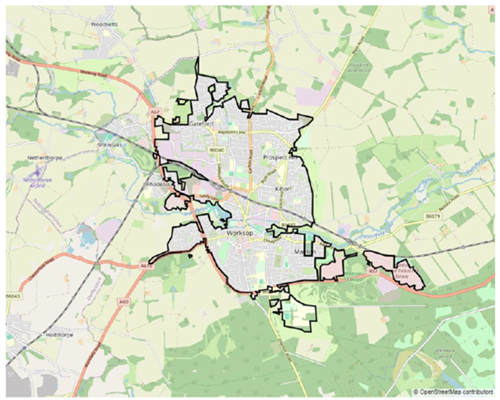
The above map shows the area of benefit approved by the Worksop Together Board. This is the ONS Built-Up Area Boundary as outlined in the Bassetlaw Local Plan (adopted in 2024). The focus areas for Pride in Place funding and interventions include Worksop Town Centre and its surrounding neighbourhoods—Manton, Cheapside, Kilton, Prospect Hill, and Gateford. These locations have been prioritised due to their strong connection to the town centre and their significant need for social, economic, and environmental improvements. This does not preclude activities taking place outside these neighbourhoods (although still within the adopted area of benefit) should there be sufficient evidence of need and contribution to the programme priorities.
Key Objectives of the Events Grant
As part of the initial community engagement undertaken by BCVS for Worksop Together, the priorities for the funding were outlined and ranked by our local community. The list of priorities is set out below:
Ranked by combined total of Important and Very Important with top 5 in bold:
| No. | Q6: These are priorities for Worksop that were identified through previous research - please state how important these are to you | Important | Very Important | Total |
|---|---|---|---|---|
| 1 | Supporting existing businesses and attracting new businesses into the town | 32.69 | 59.35 | 92.04 |
| 2 | Creating new and enhanced amenities for young people | 38.71 | 46.88 | 85.59 |
| 3 | Increased skills and workforce development | 45.59 | 37.63 | 83.22 |
| 4 | Creating community facilities within the town centre | 44.09 | 37.85 | 31.94 |
| 5 | Developing a stronger events programme within the town centre (markets, events, performances, cultural activities, etc) | 41.08 | 38.71 | 79.79 |
| 6 | Re-use of existing buildings and significant new housing in the town centre | 34.62 | 38.49 | 73.11 |
| 7 | More green space and improved public realm | 43.66 | 27.10 | 70.76 |
| 8 | Improving the evening offer within the town centre (restaurants, bars, events and activities etc) | 37.63 | 31.40 | 69.03 |
| 9 | Increasing the amount of housing choice in the area, including affordable housing | 29.03 | 38.71 | 67.74 |
| 10 | Improving transport links within other areas in the region | 36.77 | 30.32 | 67.09 |
| 11 | Improving waterfront leisure opportunities and access to the waterside | 36.13 | 22.15 | 58.28 |
| 12 | Movement around the town centre | 31.61 | 19.35 | 50.96 |
| 13 | Improving provision for pedestrians and cyclists in the town centre | 27.74 | 16.56 | 44.30 |
| 14 | Improving signage and wayfinding around the town centre | 27.10 | 8.39 | 35.49 |
The primary aim of this grant funding is to enable priority 5 of the list above: A vibrant programme of monthly events, festivals, and cultural initiatives which animate the town centre and grows the visitor economy.
- Worksop’s industrial, cultural, and natural heritage is celebrated as a foundation for renewal.
- Residents and visitors experience a stronger sense of identity and pride through cultural engagement.
- The event creates a sense of cohesion amongst the different people of Worksop
- The event creates powerful in-person connections
- The event helps to generate revenue and boosts brand awareness
- Whether for business or community, we want to fund a well-executed gathering which builds loyalty, facilitates direct networking, and helps Worksop’s organisations communicate their core values and creates pride in place.
- Will your event strengthen our social fabric and foster a sense of local pride and belonging through arts, culture, heritage or other creative programme? Does your organisation work at grass roots and local community level across a wide range of activities?
Who can apply?
- Business, community and voluntary organisations delivering events in the Worksop Designated Geographical Area
- Registered charities/community associations
- Charitable Incorporated Organisations (CIO)
- Community Interest Companies (CIC) limited by guarantee (and have charitable objectives)
- Community Benefit Societies (Bencom)
- Constituted Community Groups
- Faith Groups, where the activity is not promoting religion
- Organisations that will deliver projects to residents who are in the Worksop Designated Area
| Indicative outputs | Indicative outcomes |
|---|---|
| Number of Cultural Initiatives: Local events, heritage projects, and arts activities delivered | Improved community engagement |
| Increased social capital | Stronger social cohesion, reduced isolation, and a greater collective sense of belonging |
| Improved local economy | Increased high street footfall |
| Enhanced Safety and Well-being | Better perceptions of local safety and measurable improvements in general health and resilience. |
| Delivery of a Worksop Event or programme of events |
Number of people attending Improved perception - creating pride in place |
The following place-based priorities need to be supported:
- Pride in place: improving people’s satisfaction with where they live
- Enhancing engagement in community activities, community cohesion, and addressing anti-social behaviour
- Improve health and wellbeing
- Creating volunteer opportunities
Type of projects we will fund
Following a wide consultation with a range of strategic partners and resident groups, example projects we can fund are detailed below. The following list includes gaps in provision that have been identified but also link to the place-based priorities listed above:
- Enterprise focussed events
- Events or projects which engage young adults who are socially inactive or excluded
- Events or projects which engage young people in music, arts, creative activities or something similar
- Events which directly relate to arts, museums, and libraries
- Projects which promote suicide prevention awareness in conjunction with a particular charity
- A music club or event
- Music lessons/tuition workshops (additional staff costs)
- Events which promote Pride in Place – developing engagement in business networking and involvement, artwork, trails, sculpture, murals, community art or local heritage interests, for example
There’s a huge variety of projects and activities that we will support, including (but not limited to):
- Equipment such as materials, hire of items such as musical instruments and/or specialist resources or materials needed to undertake the event.
- Coaching or training activity (additional staff costs)
- Project costs
- Transport costs
- Improvements to facilities that support community access and/or to improve health and well-being
Financial clawback may be requested by Worksop Together through Bassetlaw District Council if money spent fails to meet criteria or funds provided are used for ineligible costs outlined below.
Eligible Costs
- Funding for resources and materials to support the specified project
- Funding for specialist practitioners to support the project (musicians, dancers, specialist artists); the grant will not fund existing staffing costs
- Transport costs for volunteers or resources
- Transport costs to enable participants to access services
- Funding for costs such as advertising, leaflets and posters to promote the project
- Applicants must ensure that the project is compliant with the UK Subsidy Control Regime and will be asked to demonstrate this within their application.
- Applicants must be legally constituted, and if the application is approved, the applicant organisation will enter into a legally binding funding agreement and therefore will carry the liability for ensuring that the terms and conditions of the funding agreement are met.
- Funding must be used to support and deliver activity in Worksop only
- The grant can be used for basic refreshments such as tea & coffee for volunteers
Ineligible Costs
The following costs are considered ineligible and must not be included in applications:
- Paid for lobbying, entertaining, petitioning, or challenging decisions, which means using the fund to lobby (via an external firm or in-house staff) in order to undertake activities intended to influence or attempt to influence Parliament, government, or political activity, including the receipt of UKSPF funding, or attempting to influence legislative or regulatory action
- Payments for activities of a political or exclusively religious nature
- VAT reclaimable from HMRC
- Gifts or payments for gifts or donations
- Statutory fines, criminal fines, or penalties
- Payments for works or activities that the lead local authority, project deliverer, end beneficiary, or any member of their partnership has a statutory duty to undertake or that are fully funded by other sources
- Contingencies and contingent liabilities
- Bad debts, costs resulting from the deferral of payments to creditors, or winding up a company
- Expenses in respect of litigation, unfair dismissal, or other compensation
- Costs incurred by individuals in setting up and contributing to private pension schemes
- Maintenance of existing buildings
- Cost of staff
- Insurance
- Monies can only be predominantly focused on delivering operational projects, not the purchase or construction of equipment or buildings
- The grant should not be used to fund staff or consultants to deliver their project
- The grant does not cover retrospective costs; it must be for a new project.
- The grant does not fund vouchers, prizes, gifts or incentives for people involved in the project.
- The grant must not be used to purchase alcohol and no more than 5% of the grant must be spent on catering, food or drinks.
Contribution rate and match funding
- Worksop Together Grant funding must not be used to replace existing funding sources. It must enable activity to take place that would not otherwise happen or to increase the scope, scale, or intensity of an already planned event.
- There is no specific requirement for match funding. If an organisation can demonstrate some level of match, however, this will be viewed favourably. This can be in financial or resource support
- Payment terms will be agreed with successful applicants prior to signing the grant agreement.
How to apply for the grant programme
The following documents must be requested from worksop.together@bassetlaw.gov.uk by applicants in order to be considered for funding. Please send them back to worksop.together@bassetlaw.gov.uk once they are completed.
- Grant Funding Application Form
- Budget and Performance Profile
In addition, please email one of the following to support your application:
- A copy of audited accounts for the last two years.
- A statement of the turnover, profit and loss account (income statement), balance sheet (statement of financial position), and statement of cash flow for the most recent year of trading for this organisation
- Alternative means of demonstrating financial status if any of the aforementioned are not available, such as a forecast of turnover for the current year and a statement of funds provided by the owners and/or the bank, charity accruals accounts, or another method
Before we award the grant, we will need to see copies of the following:
- Equality and Diversity Policy
- Safeguarding Policy where you are working with children or vulnerable adults
- Health and Safety Policy
- Public Liability Insurance Policy
Completed applications must be submitted by 17th July at midnight.
Assessment Criteria
Stage 1: Gateway Criteria
| Criteria | Pass | Fail | Partial |
|---|---|---|---|
| Criteria 1: Application signed, fully completed and returned on time | |||
| Criteria 2: Applicant meets eligibility criteria | |||
| Criteria 3: Economic and Financial Standing* Finance Risk* |
|||
| Criteria 4: Prior Contract Performance | |||
| Criteria 5: Provision of Subsidies | |||
| Criteria 6: Policies | |||
| Criteria 7: Liability Insurance |
*These will also be assessed via due diligence checks.
Applications that fail any criterion cannot progress to Stage 2: Scoring.
For the questions which have been assessed as partial, progress to Stage 2 is allowed. Scoring will be allowed with justification from the Assessor.
Stage 2: Scoring
The maximum score for each question is 5, based on the scoring framework below.
| Score | Assessment | Description |
|---|---|---|
| 0 | Unacceptable | Response to the question is unacceptable, or no response was received. Does not give the fund confidence in the ability of the bidder to deliver the contract. |
| 1 | Poor/Weak response | Inadequate detail provided, or some of the answers are not directly relevant to the question. Is supported by none or a weak standard of evidence in several areas, giving rise to concern about the ability of the bidder to deliver the contract. |
| 2 | Below Expectations | Limited information provided and/or a response that is inadequate or only partially addresses the question giving rise to concern about the ability of the bidder to deliver the contract. |
| 3 | Satisfactory Response | Acceptable response in terms of the level of detail, accuracy, and relevance. Is supported by a satisfactory standard of evidence in most areas, but a few areas lack detail or evidence, giving rise to some concerns about the ability of the bidder to deliver the contract. |
| 4 | Good Response | Comprehensive response in terms of detail and relevance to the question and supported by a good standard of evidence. Gives the fund confidence in the ability of the bidder to deliver the contract. Meets the fund’s requirements. |
| 5 | Very Good Response | As good, but to a better degree in terms of precision and relevance. Is comprehensive and supported by a high standard of evidence. Gives the fund a high level of confidence in the ability of the bidder to deliver the contract. May exceed the Fund’s requirements in some respects; for example, added value such as integration or synergy with other projects. |
Stage 3: Moderation
Funding will be awarded to the applicants with the highest scores.
Worksop Together reserves the right to invite applicants to discuss the application when scores are very close and/or clarification is required.
Notification of invitation to bid outcome
Once the outcome of the assessment process has been notified to all applicants, organisations can request feedback on their applications and scoring. This will be provided within 14 working days of the request.
Evaluating the Project
If you are successful, evidence of your spend will be required. Depending on the amount of grant you receive, you may need to attend monthly/quarterly meetings, provide invoices and receipts and/or submit a report at the end of the project which could include photographs of the event/workshop.
Communications and marketing
Worksop Together will want to share details of the funding allocations, grant recipients and the projects it has funded. Hence, it is expected that you will share detail of your project with our comms team and provide regular updates that we can share on our various websites and platforms. To that end, project deliverers must ensure that the appropriate UK government and Pride in Place logos are used prominently in all communications materials and public facing documents relating to funded activity – including print and publications, through to digital and electronic materials.
Logos that will be required for social media posts and promotions linked to funding:
- Pride in Place
- Worksop Together
- Bassetlaw District Council
For further information or questions please email: worksop.together@bassetlaw.gov.uk
Event Planning
Bassetlaw District Council can assist with event planning.
Whether the event is large or small, held for a Charity or has a commercial purpose, the Safety Advisory Group at Bassetlaw District Council are here to help and advise with the planning details to help your event go safely.
The role of the Safety Advisory Group (SAG) is to promote good standards of safety at all public events within the District and ensure that best practice is followed to:
- Provide a high level of safety at public events;
- Promote Good practice in safety and welfare planning for events;
- Ensure events cause minimal adverse impact on the local community
Please read the guidance on Event Planning and Safety and tick the relevant box on the application form to confirm you have understood and completed the Event Notification Form.
Appendix 1: Martyn's Law
This new statutory guidance, issued by the Home Office, in recognition of Martyn Hett, one of the 22 victims of the Manchester Arena attack in 2017, intends to improve preparedness and security across the UK. It requires those responsible for premises and events to take steps to prepare for potential attacks and keep people safe. Many of the events may fall out of scope for implementation of Martyn’s Law, but please read through the guidance to ensure you have considered the implications of Martyn’s Law on your event; also, the Act does not supersede other legislation, and all legislation must be complied with. Those who have requirements placed on them by this Act may also have obligations under other legislation. This includes, but is not limited to, legislation relating to health and safety, fire safety and licensing, as well as obligations under the Equality Act 2010. The responsible person will want to consider other relevant legislative requirements when meeting the Act’s requirements.
Below are two flowcharts to assist with the actions required under the Act for premises and events:
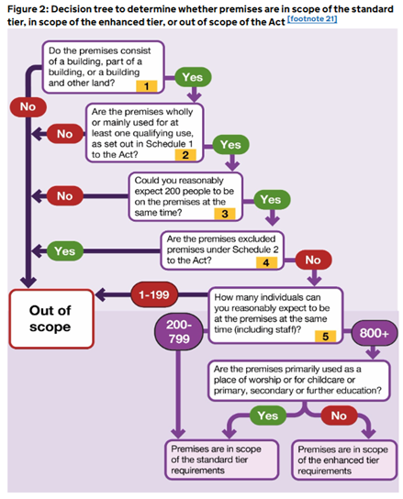
Key
- The definition of premises can be found in section 2(2) of the Act.
- The categories of use set out in Schedule 1 to the Act are:
- Shops etc
- Food and drink
- Entertainment and leisure activities
- Sports grounds
- Libraries, museums and galleries
- Halls etc
- Visitor attractions
- Hotels etc
- Places of worship
- Health care
- Bus stations, railways etc
- Aerodromes
- Childcare
- Primary and secondary education
- Further education
- Higher education
- Public authorities
- The Act specifies that premises within the standard tier will reasonably expect from time to time to have a maximum number of between 200 and 799 individuals (including staff) at the same time in connection with one or more Schedule 1 uses. For enhanced tier premises or qualifying events, it is 800 or more individuals (including staff).
- Excluded premises in Schedule 2 to the Act include:
- Legislatures and devoted administrations.
- Parks, gardens and other open-air premises used for recreation or leisure (only applies to open access premises which do not have measures to secure or check that access is restricted).
- Transport premises that are already subject to relevant existing legislative requirements to consider and mitigate threats.
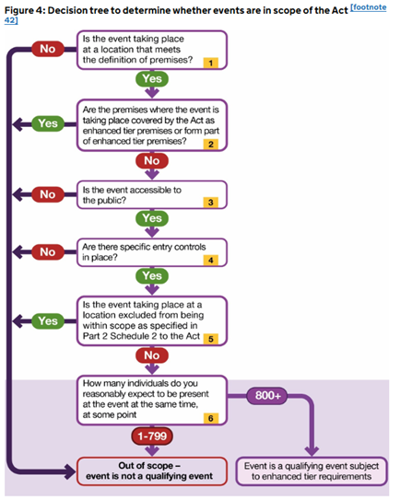
Key
- The definition of events can be found in section3(1)(a) of the Act.
- The event must be taking place at a location that is not already in the scope of the Act as enhanced tier premises. If the premises meet the criteria to be enhanced tier premises, please see the infographic on qualifying premises.
- Members of the public must be able to access all or part of the premises for the purpose of attending the event. Events will not be qualifying under the Act where the condition for entry is personal to the attendees and, as a result, access is not open to the public.
- The event must have measures in place to check that attendees satisfy a condition of entry. This is the requirement that, to enter the event, members of the public have paid, have a ticket or pass, or are members or guests of a club, association or similar body.
- Certain events are excluded from being qualifying events under Part 2 of Schedule 2 of the Act. These are:
- an event held at premises specified or described in the following paragraphs in Schedule 2 to the Act.
- Paragraphs 1 and 2 (legislatures and devolved administrations).
- Paragraph 4 (transport security).
- an event that is to be held at premises wholly or mainly used for a use specified in the following paragraph of Schedule 1: paragraph 9 (placed of worship), paragraph 13 (childcare), paragraph 14 (primary and secondary education), or paragraph 15 (further education).
- an event held at premises specified or described in the following paragraphs in Schedule 2 to the Act.
- To be in scope, it should be reasonable to expect that 800 or more individuals will be present at the event at the same time, at some point during the event. This figure must include staff working at the event. Only those attending or working in the part of the premises connected with the event should be captured.
Find out how you can assess reasonable expectation for your event by reading this content: Terrorism (Protection of Premises) Act 2025: Scope (Events) - GOV.UK
Last Updated on Tuesday, August 18, 2026